Biotensegrity is a new(ish) approach to understanding how bodies work based on the insight that we are primarily tensegrity structures and our bones do not directly pass load to each other. Thus, forces primarily flow through our muscles and fascial structures and not in a continuous compression manner through our bones. In fact, our bones do not directly touch each other, and are actually floating in the tension structure created by our fascial network. Thus, biotensegrity represents a significant conceptual shift from the common sense view that our bones are the load bearing structures in our bodies like the framing of a house.
The first person to start applying tensegrity concepts to complex biological organisms was Dr. Stephen Levin, an Orthopedic Surgeon. He has been studying and writing about this concept for over 20 years. He makes the compelling point that looking at the bones as a system of continuous compressions members, like the beams and rafters of a house, results in force calculations predicting the shearing and crushing of bones under regular daily loads. It is only by modeling the transmission of forces in the tensional members of our bodies (the muscles and connective tissue) that we can account for our ability to perform simple everyday tasks. He has a number of informative papers on his site, I would recommend starting with The Tensegrity-Truss as a Model for Spine Mechanics: Biotensegrity.
Another major contributor to the field of Biotensegrity is Tom Flemons. Since 1985 Tom has been actively involved in designing and inventing tensegrity representations of human anatomy and his models help highlight key principals of biotensegrity.
Tom builds a number of tensegrity models of the spine. A common conceptual model of the spine is that the vertebrae are stacked on top of each other and pass force compressively from one to the other. Problematically, this implies that all the force is passing through the soft disks between the vertebrae. If that were happening, those disks would be crushed and ground apart as we move and rotate our spines around. Tom’s biotensegrity spinal models show that it is possible to build a flexible and mobile spinal column where the vertebrae float apart from each other without touching.
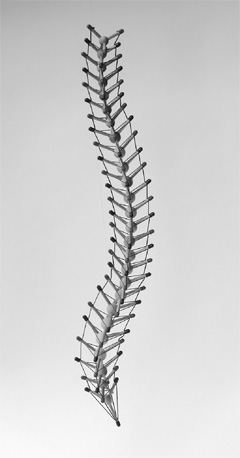
Tom Flemon’s Tensegrity Model of the Spine
What is interesting about these models is that you can press down on them, rotate them, turn them upside down, and as long as the tension members stay intact, the vertebrae stay separated. This is exactly the type of property one desires in a living moving structure. In fact, it helps highlight the cause of common spinal dysfunctions like bulging disks. If the tension network (i.e. fascial web and associated muscles) becomes weak due to injury or lack of appropriate exercise, then it cannot necessarily hold the vertebrae apart anymore. Thus, in a weak back the experienced forces will start passing compressively through the disks between vertebrae, causing them to crush and bulge out. Our highly sedentary lifestyle encourages the atrophy of critical weight-supporting spinal muscles. As a result we suffer from back pain, bulging disks, and other failures of the spine. Go exercise!
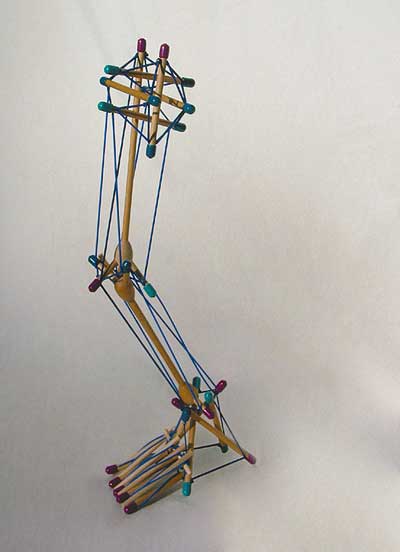
Tom Flemon’s Tensegrity Model of a Leg
What is fascinating about Tom’s model of the leg is that the “bones” are able to float without touching each other at the knee. This separation can hold, even when one pushes down on the top of the model simulating the weight of the rest of the body. This matches human function — if our bones end up touching it becomes a source of dysfunction. In my own experience, I’ve had multiple knee surgeries and found for some years that my knee would crunch and grind under certain conditions. This was amazingly painful and would lead to inflammation and trouble. As I strengthened and rebalanced the tension in my leg muscles the joint was able to gain more space again and my bones stopped grinding on each other. The body’s natural reaction to force applied to bones is to grow more calcium deposits. Thus one possible explanation for arthritis is that the tensegrity structure around the joints was too weak and the bones were rubbing, when they shouldn’t be.
Tom’s biotensegrity models are static models and only show the distribution of forces for a certain pose of the leg. Thus, they do not look exactly like a full anatomical model of the leg because a real leg moves through a wide range of motion. How to take these static models of single poses and apply them conceptually to a living, moving, dynamic structure will be the topic of a future post.
UPDATE To see some of my recent work on applying biotensegrity concepts to robotics, see my post on a robotic tensegrity snake, development of a tensegrity based planetary lander, and a video of a lecture I gave in Switzerland.




Saw an article on this topic in Men’s Health awhile back, very interesting. So what exercises did you do to strengthen your knees?
Hey Bruce!
No one specific exercise. Lots of yoga, biking, and walking. The yoga helped me understand the proper alignment, and lengthened and strengthened many of the muscles. I think the final touches were put on when we moved onto Potrero Hill and I was walking up the hill every day. That was good strengthening! Overall though, it was a many year process with many stages of learning and improving and growing stronger.
Hello. The problem with most exercise recommendations is that very few know about exercises that respect the tensegrity principles and biomechanics. That is not a bad thing its just the state of our exercise and rehabilitation fields at this time. For the sake of a blog replay, exercise can be broken down into global movements like taking a yoga class, walking etc or analytic exercise- a very precise type of exercise. To strengthen the knee the better question is, how to strengthen what part of the knee? The best program in the world right now is the SomaTraining and ELDOA programs based on the work of Guy VOYER, DO. In the United States, the only permanent English-speaking school is in Dallas- Legacy Sport & Wellness Center. It is here that you can get a proper exercise program to reinforce the parts of the knee that need to be addressed using specific exercises.
Do Summo dead lifts. The adductors attach to the fascia and help to seperate the tibia and femur. This is for degenerative changes of the cartilage. There are other treatments depending on which knee condition is present.
My cousin recommended this blog and she was totally right keep up the fantastic work!
Great site. A lot of useful information here. I’m sending it to some friends!
There are many different types of exercises for “the knee” depending on what the a specific knee requires, but first, if a knee is a problem the pelvis must be balanced first and if there are biomechanical problems in the ankle or foot those need to be considered in addition to the work specific to the area and structures of the knee that need to be addressed. To list all the possible exercises that can be recommended for the knee joint in a forum such as this is not possible, but I can say this… 1. If you have a knee problem the gravity squat needs to be mastered first before loading the structure. For more on that visit legacyperformwell.com and search gravity squat and gravity line. 2. Prior to the gravity squat exercise, proprioception for “damaged area” is done first- specific proprioception, for example, for the ACL, LCL, MCL or for a common ailment, patellar femoral syndrome. It is unlikely you will find these types of exercises in a classic rehab clinic in North America as most of the proprioceptive exercises that are taught are very general- like standing on a board or foam pad. These exercises only increases the gradient of proprioception between the structures as opposed to balancing them. This is worse than no proprioception at all. After the pelvis is in balance, proprioceptive exercise and the gravity squat the question often is asked, “Can I do squats, lunges, leg extensions…” Forget the leg extensions, but to answer if you should squat or lunge depends on the posture of the femur in relationship to the tibial plateau, the fibula and their biomechanics. For example, if you have had ACL the alignment of the those joints is very important to respect because if the alignment is compromised a shearing can taking place resulting in further wear to the joint. After classic exercise, myo-fascial stretching is needed to re-organize the fascia in relationship to the ligamentous structures and the muscle located inside the “skin” or fascial chains. This re-organization helps to “create space” or decoapt the joint ensuring adequate space for fluid to circulate amongst the synovial membranes. This work is discussed in more detail in courses taught by Guy Voyer DO.
Thanks for sharing some great information! I’m glad to see folks sharing their knowledge here!
The anatomical construction of the skeleton of vetebrates is clearly not a stack of bricks. The break dancer in Steve Levin’s video demonstrates the inadequacy in the classical biomechanical concept quite irrefutably.
But the newish concept of biotensegrity still involves small zones of physical contact between compressive and tensile elements (or parts). The compression values in this small contact zone, is also biolgically as unsustainable as it is in the fulcrum model of compressive levers, or is the bearing of an axle. The final assembly stages of a physical tensegrity still requires enormous local forces!
The biotensegrity model (the physical model) is a step in the right direction, but the mechanics of the compression-tension duality of tensegrity, still remain embedded in dualistic classic presumptive models.
Steve Levin has unfortunetly cited a version of Newtions laws (from Wiki) that involves the concept of “unbalanced forces”. Determining whether a force is balanced, necesitates the incorporatation of a fulcrum into the mechanical assessment. The fulcrum is not part of Newton’s personal statement of his laws.
Newton states that forces arise when bodies penetrate one another’s dimensions. Tensegrities are quite interesting structures as their ‘dimensions’ are quite permeable to each other (in static constructions at least). However, dynamic tensegrities are quite another story.
Planetary gravity is quite a useful dynamic ‘tensile element’ because it is, unlike wire, permeable to the motion of compressive elements. In other words, we can speculate that human biotensegrities incorporate open source gravity to make them intrinsically dynamic. This issue needs to be better understood before tensegrities become true intergalactic explorers.
I would add something I’ve been meaning to write about more: I suspect that there are contact forces between bones during certain transient impact events — such as running or jumping — it is reasonable for the body to rely on the cushion of disks/meniscus, etc to handle these momentary events. But under normal operation the compressive forces are kept apart, as is needed to keep the soft tissue in the joints from being ground away.
You can take this further and realize that the body, through its tension network, can control (to some extent) the force transferring compressively in the joint. It is not unreasonable to assume that some small amount of compression is normal — enough to maintain positive contact of the bones which helps with stabilizing the joint (and helps the system know where all the components are), but not enough to wear and tear on the components — most of the force is still in the tension network. This is useful because it means graceful degradation is built in — as injury and weakness occur to the tension network, one would expect greater amounts of force to pass compressively through the bones. A robust system that survives in nature must assume a natural state of some amount of injury and degradation, yet still must be highly functional.
In this hybrid version, the biotensegrity system is still the primary load path for forces in the body, but we are allowing for a graceful degradation to a secondary pathway (bone on bone compression), which is sub-optimal, but useful for real-world survival.
I would expect that very few people are in “optimal physical condition” and thus experiments on folks would in fact find that most people experience some bone on bone force transfer — possibly leading to arthritis or other problems later in life.
Why does no one bring in fluid dynamics into this model ? The body is between 60 -70 % water .
Good point. I presume this is 60-70% by weight.
The structure of water is crucial in biological structures (apparently about 97% of molecules in biological bodies are water). That means, statistically, protein molecules and the like are so numerically insignificant, that they can be justifiably ignored! Understand the mechanics of water first and the rest will fall into place.
Gerald Pollack is pioneering research in this field. The consequences are so radical to all biological models, that I cannot even identify them.
An excellent article! In my teaching and training it is evident that once we learn how to accurately perceive the structure of our own human form then all optimum movement (movement that doesn’t damage the body) has biotensegrity at its core.
“If you perceive your movement as having only one direction then you have made a big mistake!” Wang Xiang Zhai
Except for terminology, these are concepts taught and appreciated by Osteopaths (traditional UK type, not American MD) from the days of Still, Sutherland etc. I am delighted that they are finally becoming more understood in the ‘mainstream’, however the following is clearly not entirely accurate
‘”The first person to start applying tensegrity concepts to complex biological organisms was Dr. Stephen Levin”
when clearly he has simply understood these concepts from his own paradigm and applied them. However he is not the first to explain in detail the tensegrity, fluid oscillations and inherent interdependent nature of the human form. For example see “Teachings in the science of Osteopathy – Sutherland”, and the therapeutic approach to working through this understanding has been developed for over 100 years by Osteopathic studies before Dr Levin presented his new findings. Not belittling the importance and genius required to come to these conclusions, and excellent that it is becoming widely understood. But to agree that building and developing on work by others who were pioneers in this field is a more respectful way to present this ”new” concept.
Please don’t flame me too much – just presenting my thoughts!
Thanks! This is great! I’ve known of the similarity to Osteopathic approaches, but have not yet read Sutherland’s works. I appreciate the correction!
Alexander Technique
This is all wonderful information! I’m curious as this post has been up for a number of years, how people see the neurology of the body (the nervous system) playing a role in unlocking the tension patterns in the tensegrity structure of the body? Having too much focus on the anatomy and physiology leaves too much out of the equation for the body to release dysfunctional tension patterns. In my experience personally and working with clients that’s where leverage in the body healing itself lies.